
(1911, rev. 1946) 1911 Tpt. 1 & 2 in B♭ and A Cor. 1 & 2 in B♭ and A. 1946 Tpt 1*, 2, and 3 in C and B♭. Scores *Excerpts on pages 5-6. |
 Waltz (the Ballerina and the Moor)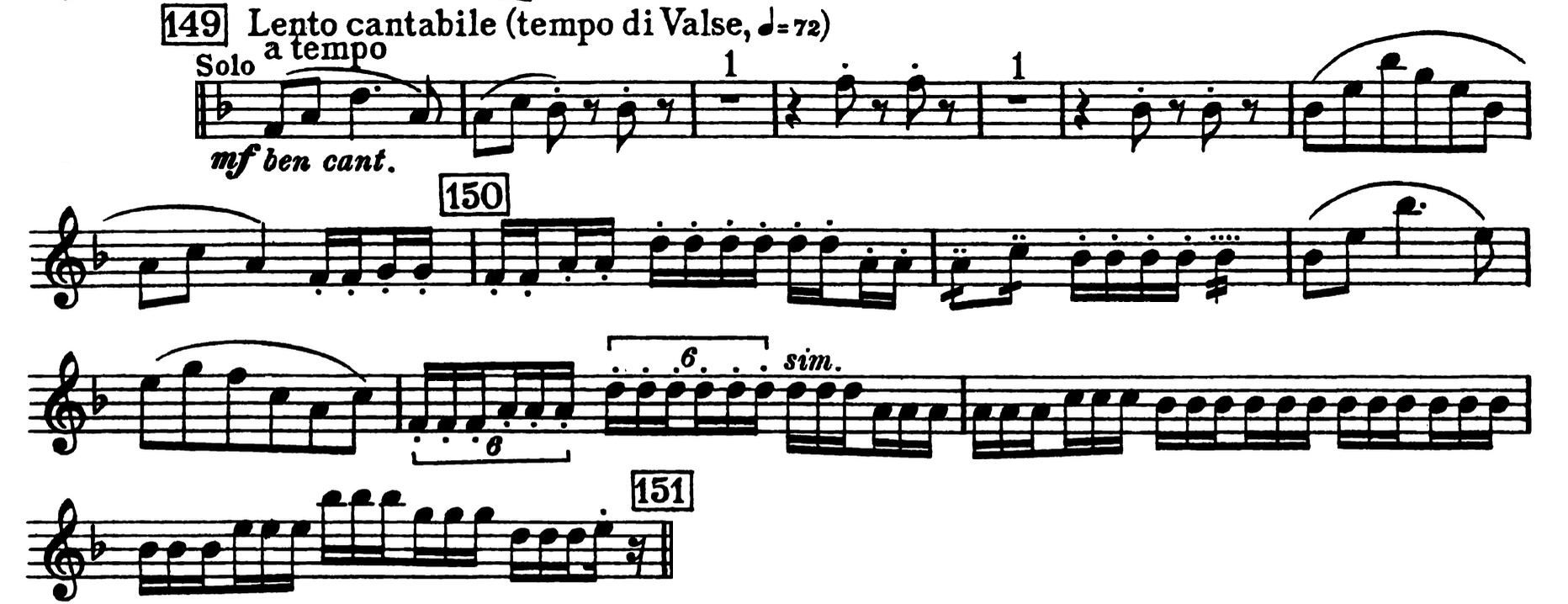
ABOUT
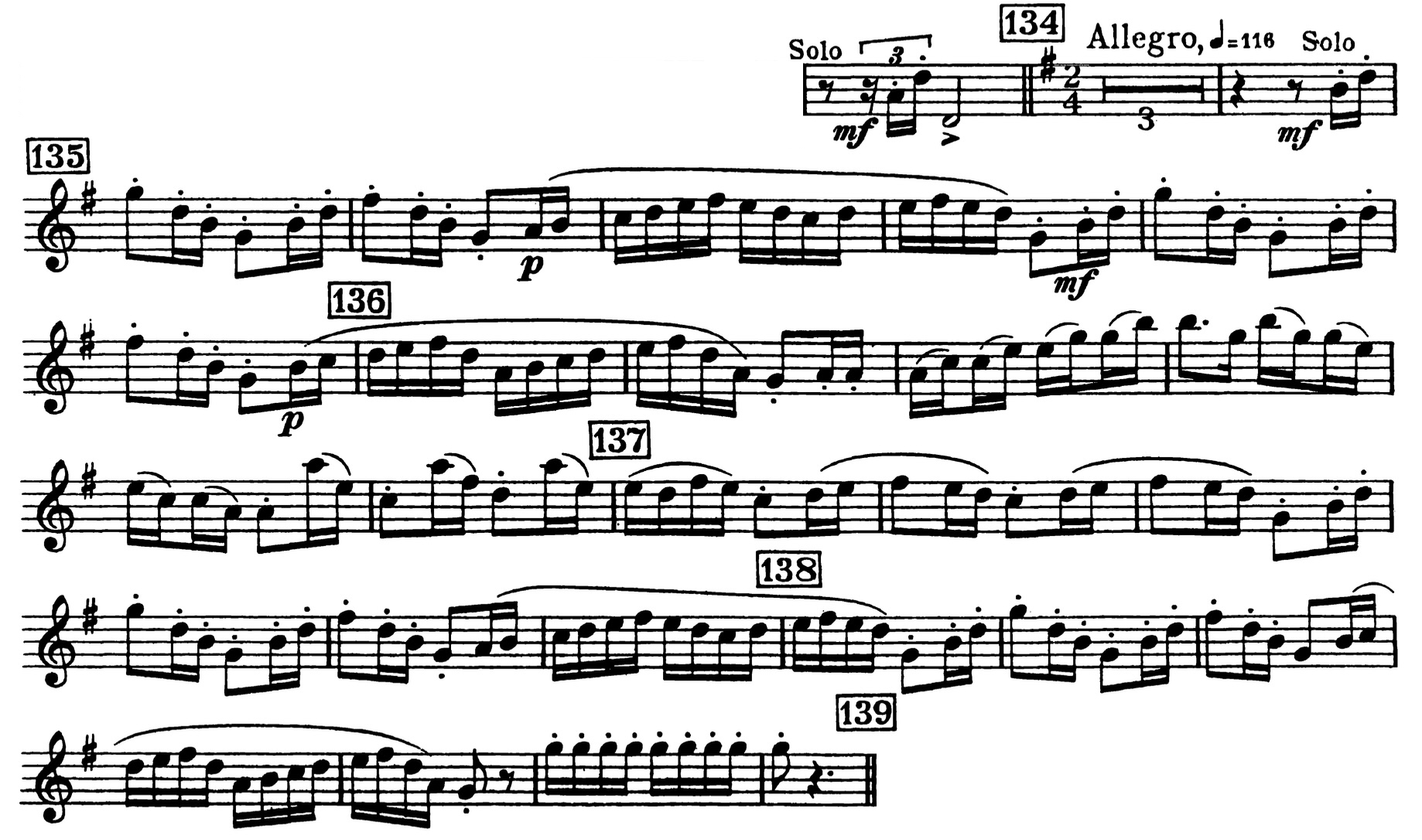
Petrushka is a Top Five excerpt. It comes from the third of the ballet’s four tableaus. In the scene, the Ballerina is ushered to the Moor’s room. With a toy trumpet, she plays a jaunty tune for him, miming to the playing of the orchestral trumpeter. Her “Dance of the Ballerina” is the excerpt at the top of the page.
After the Ballerina has charmed the Moor, he dances a Waltz with her. This is the second major excerpt from Petrushka. The tune is a quotation from Joseph Lanner’s Styrian Dances. The entire ballet is riven with similar borrowings. Not long after the Waltz, Petrushka arrives and chaos ensues.
The entire trumpet part of Petrushka is a gem. It is full of great moments. Some are charming and simple. Others require a great deal of effort and produce a fantastic effect. The 1911 ballet is written for 2 trumpets and 2 cornets. The 1946 revision consolidates the 4 parts into three without cornets. All the soloistic passages that were played on cornet in the original were now played on trumpet, which reflects the overall shift away from the cornet in the field.
The “Dance of the Ballerina” is played by Piston I in the ballet, and it differs slightly from the 1946 version for trumpet. The original passage has only one dynamic: mf. Aside from slurs, there are no articulation marks, and the low G of the phrase is always returned to via slur from the previous phrase. In the 1946 version, Stravinsky alternates the dynamic between mf for the opening figure, and p for the scalar passages. After the second p marking before Rehearsal #136, Stravinsky stops indicating the dynamics. The implication is clear enough that the two types of material should be played at different volumes. That is how the excerpt is almost always played. The trumpeter who assiduously follows Stravinsky’s score would play the entire second half of the excerpt quietly.
In the 1946 version, Stravinsky also adds staccato markings to the opening figure whenever it recurs, as well as the final repeated G. Instead of returning to the low G via slur, it is always re-articulated. On the repetition of the opening arpeggios, Stravinsky omits the staccato mark on the final G. Nearly every trumpeter ignores the printed music and keeps the note short to match its predecessors.
Petrushka appears in Volume I of Bartold’s Orchestral Excerpts (pp. 41–6). He prints the 1911 version of the parts. Phil Smith includes it as the first track on Orchestral Excerpts because it is, “by far the most requested audition excerpt”.
After the Ballerina has charmed the Moor, he dances a Waltz with her. This is the second major excerpt from Petrushka. The tune is a quotation from Joseph Lanner’s Styrian Dances. The entire ballet is riven with similar borrowings. Not long after the Waltz, Petrushka arrives and chaos ensues.
The entire trumpet part of Petrushka is a gem. It is full of great moments. Some are charming and simple. Others require a great deal of effort and produce a fantastic effect. The 1911 ballet is written for 2 trumpets and 2 cornets. The 1946 revision consolidates the 4 parts into three without cornets. All the soloistic passages that were played on cornet in the original were now played on trumpet, which reflects the overall shift away from the cornet in the field.
The “Dance of the Ballerina” is played by Piston I in the ballet, and it differs slightly from the 1946 version for trumpet. The original passage has only one dynamic: mf. Aside from slurs, there are no articulation marks, and the low G of the phrase is always returned to via slur from the previous phrase. In the 1946 version, Stravinsky alternates the dynamic between mf for the opening figure, and p for the scalar passages. After the second p marking before Rehearsal #136, Stravinsky stops indicating the dynamics. The implication is clear enough that the two types of material should be played at different volumes. That is how the excerpt is almost always played. The trumpeter who assiduously follows Stravinsky’s score would play the entire second half of the excerpt quietly.
In the 1946 version, Stravinsky also adds staccato markings to the opening figure whenever it recurs, as well as the final repeated G. Instead of returning to the low G via slur, it is always re-articulated. On the repetition of the opening arpeggios, Stravinsky omits the staccato mark on the final G. Nearly every trumpeter ignores the printed music and keeps the note short to match its predecessors.
Petrushka appears in Volume I of Bartold’s Orchestral Excerpts (pp. 41–6). He prints the 1911 version of the parts. Phil Smith includes it as the first track on Orchestral Excerpts because it is, “by far the most requested audition excerpt”.
TOOLS
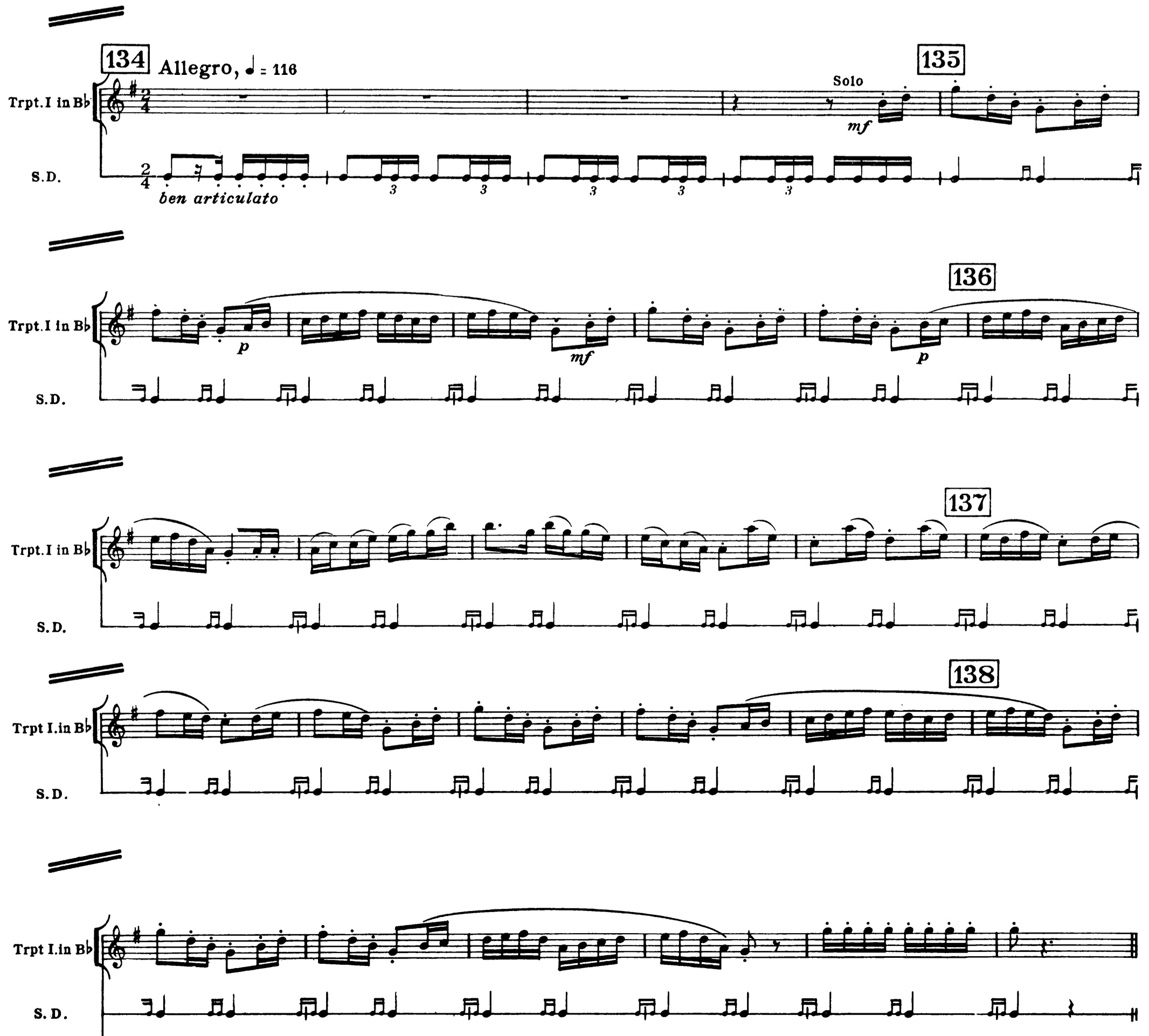 The score for The Ballerina’s Dance is sparse. The snare drum is the only other instrument playing with the trumpet. Playing Petrushka with the drummer is easier than playing it solo. Rehearsing Petrushka with a friendly percussionist is great exercise.
 These snare drum tracks are serviceable substitutes. Stravinsky indicates a tempo of 116 beats per minute in the 1946 revision. In the 1911 original, the tempo is simply marked Allegro. There are three additional tempi, two slower and one faster for the challenge.
Follow the cardinal rule for learning difficult music: Do not increase the tempo until the entire passage is mastered. Petrushka does not pose problems for most people until the eighth bar and the ensuing arpeggios. The pace at which those can be accurately executed sets the pace for the entire excerpt. Slowing down for the difficult bits is a recipe for frustration.
Many players will use both a C and B♭ trumpet to perform the entire suite. Stravinsky notates the part in both keys. Playing the entire part on B♭ feels great, but passages like “Danse Russes” become much harder than they need to be on the larger instrument. Some trumpeters swear by playing the “Dance of the Ballerina” on their C. The entire excerpt feels much easier in F major.
By that logic, some folks bring their E♭ or D trumpets to auditions for this excerpt. Transposing Petrushka is a great exercise on any horn. It keeps the brain from fatiguing and helps keep the muscles fresh. Jazz players routinely practice licks in every key to make them second nature. Petrushka In All 12 Keys is a helpful resource to aid in transposition and practice. It continues above the written range, as well. Pushing past a natural limit recontextualizes it. After playing Petrushka up a minor third, climaxing on a high D, the original excerpt appears much more inviting. This is why baseball players use weighted bats in the on-deck circle.
SOURCES
Bartold, Gabriel. Orchestral Excerpts from the Symphonic Repertoire for Trumpet, Volume I. International Music Co., 1970.
Peyser, Joan. To Boulez and beyond: Music in Europe since the Rite of Spring. Billboard Books, 1999.
Peyser, Joan. To Boulez and beyond: Music in Europe since the Rite of Spring. Billboard Books, 1999.
